Zip Lining in Nyungwe Forest National Park
Zip lining in Nyungwe Forest National Park: Located in the southwestern region of Rwanda near the Burundi border. The park was designated as a forest reserve in 1933 and became a national park in 2005, encompassing an area of 1,019 km featuring various vegetation types, including tropical rainforest, grassland, swamp, and bamboo vegetation. The park is a UNESCO World Heritage Site, including 13 monkey groups, 300 bird species, and 1,068 plant species.
Nyungwe zip lining is a hidden gem of Africa’s safari experience, providing guests with a breathtaking view of the continent’s oldest rainforest. Visitors are afforded a unique opportunity to ascend above the dense verdant forest. While the park is renowned for its canopy walk, Chimpanzee tracking, and hiking trails, zip lining has just been incorporated among the activities available in Nyungwe Forest.
Zip Lining in Nyungwe national park is best for nature enthusiasts, bird watchers and thrill-seekers. The following provides comprehensive information regarding zip lining at Nyungwe Forest.
In Nyungwe, zip lining is a meticulously organized endeavor that integrates exhilaration, sustainability, and the environment. The zip line commences at the Uwinka Reception Center and was initiated as a component of a broader initiative by African Parks and the Rwanda Development Board.
African Parks, in partnership with Rwanda, manages the site to ensure that all tourism activities foster local employment and contribute to the park’s conservation efforts. The journey serves as a personal delight while also enhancing environmental sustainability, as guides, rangers, and infrastructure teams are sourced from local communities. The seamless incorporation of zip lining with Nyungwe’s conservation objectives is one of the sport’s most distinguished characteristics.
Length and Height
It is among the longest zip lines in Africa, comprising three segments totaling an impressive 1,935 meters in length. The first 350 meters provide an overview of the woodland’s edge. The second segment progresses rapidly over 500 meters, navigating between ridge lines and towering trees. The final 1,000-meter segment offers a stunning vista of the rugged terrain, arboreal canopies, and distant hills shrouded in mist. Riders are elevated 20 to 50 meters above the ground and can reach velocities of up to 60 kilometers per hour.
Zip lining experience in Nyungwe Forest National Park
The zip lining experience encompasses the interplay of human adrenaline and pristine nature, rather than just focusing on elevation or pace.
Prior to take-off, participants must attend a safety briefing and are equipped with professional-grade gear, such as helmets, gloves, and harnesses. Certified guides oversee the operation and ensure compliance with all international safety rules. A moment of silence ensues as you depart from the platform, during which the forest seems to suspend its breath.
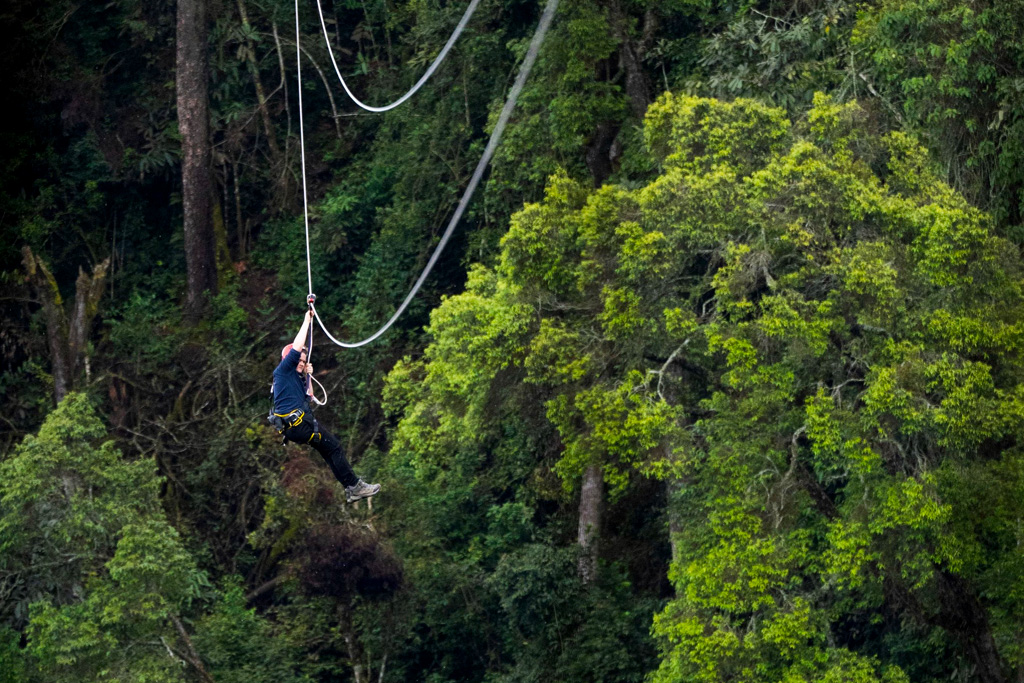
An expansive expanse of verdant treetops extends to the horizon, birds flit across your path, and intermittently, you observe colobus monkeys leaping through the branches as the wind rushes by your ears and the vista unfolds. It is an empowering and freeing experience that underscores the forest’s vitality in both manifest and latent forms.
Zip lining through Nyungwe Forest offers a unique opportunity to engage with one of Africa’s few remaining montane rainforests from an entirely distinct vantage point, elevating it above a mere thrilling activity. This experience will remain with you long after your feet have returned to the ground, embodying a celebration of nature, conservation, and community empowerment.
Instructions
While the majority of individuals can physically engage in zip lining, many restrictions exist.
The minimum weight is approximately 40 kg, while the maximum weight is around 120 kg. Children over the age of ten are allowed if they meet the stipulated minimum weight requirement.
While the sport is exceptionally safe for individuals in perfect health and modest fitness, it is not recommended for those with cardiac conditions or recent surgical procedures.
Cost of zip lining in Nyungwe Forest National Park?
The zip line adventure costs $100 for foreign non-residents and $80 for African residents. For East Africans, there is a local cost of 20000 Rwandan francs. Packages that include the zip line with other popular attractions, such as the canopy walkway or the newly established rope course adjacent to the Gisakura entrance, are also available. These packages offer variety and worth, rendering them ideal for guests seeking a comprehensive day of forest exploration.
Best time For Zip Lining In Nyungwe Forest National Park
The best time to experience Nyungwe’s zip linigng adventure are the dry seasons, specifically from June to September and December to February. Nonetheless, the line remains operational during the entire year. The forest teems with the bustle of birds, monkeys, and the rustling foliage stirred by gentle mountain breezes during these months of clear sky and dry platforms.
To ensure quality and safety, bookings must be made well in advance, particularly during peak travel periods in July, August, and the December holiday season, when daily capacity is limited.
Advance planning is recommended due to the possibility of temporary closures for safety during the rainy seasons, typically occurring from March to May and again from October to November.
How to Get To Nyungwe National Park
By road from Kigali
Roughly 6–7 hours via the scenic Butare–Huye route. The drive passes through lush tea plantations and rolling Rwandan hills. Many visitors break the journey at Nyanza King’s Palace or the Butare National Museum.
By charter flight
Akagera Aviation offers charter flights from Kigali to an airstrip near the park, significantly cutting travel time. Ideal for short itineraries or luxury travellers.
Uwinka Reception Centre
The zipline starts here. Also the base for the canopy walkway trail. Located on the main Huye–Cyangugu road (RN2), easy to spot with park signage.
Gisakura Reception
The rope course is located here, near the southern end of the park. This entry point also offers access to waterfall trails and chimpanzee trekking sectors.
What to bring & practical tips
Wear closed, grip-soled shoes. Open sandals or flip-flops are not permitted on the zipline or rope course.
Comfortable, layered outdoor clothing works best — the forest can be cool at altitude (around 2,000m) and wet in the wetter months.
Carry a valid passport or official ID for park registration at the entrance gate.
A secure action camera or small mirrorless camera is ideal.
Loose items should be secured or left at the base — bags are not permitted on the line.
Average fitness is sufficient — but note that access trails between platforms require moderate hiking on sometimes steep, rooted paths.
Arrive early. Morning starts mean calmer conditions, better wildlife sightings, and you beat afternoon mist that can roll in over the ridge.
Pre-book through a our contact us page or simply through email at book@aloyosafaris.com Rwanda safari operator. Walk-ins may not be accommodated during peak months.
Sustainability & community impact of Zip Lining in Nyungwe National Park
The zipline was developed by African Parks and the Rwanda Development Board as part of a broader sustainable tourism strategy. All guides and infrastructure workers are recruited from surrounding communities, ensuring that visitor spending flows directly back into local communities.
A portion of zipline revenues is also reinvested into wildlife conservation — funding anti-poaching rangers, habitat monitoring, and chimpanzee tracking programmes. Choosing to zipline at Nyungwe is, in a meaningful sense, an act of conservation.
The zipline project is projected to attract 3,500 visitors in its first year, rising to 9,000 annually by year five — momentum that the Rwanda Development Board expects will sustain ongoing park improvements.
Activities to Combine with Zip Lining in Africa include, Canopy walkwa, Chimpanzee trekking, Waterfall trails, Community visits, and Tea plantation tour
Many visitors pair a half-day zipline session with the nearby Canopy Walkway — a 160m-long suspension bridge hanging 70 metres above the forest floor — in a single full-day expedition from the Uwinka Centre.
Where to stay
Accommodation options near Nyungwe range from the luxury One&Only Nyungwe House to mid-range lodges and basic campsites along the park boundary. The newest addition is Munazi Eco Lodge, located just 5 km from the Uwinka Visitor Centre — a park-owned eco-lodge with nine A-frame chalets offering panoramic forest views, a VIP room with a jacuzzi, and direct access to the zipline, canopy walk, and chimpanzee trekking. Munazi is designed so that all proceeds support the park’s long-term sustainability. Book ahead through book@aloyosafaris.com
Prices and schedules are subject to change. Always verify current rates before booking.
The Nyungwe Zipline is set to be the longest zipline in East Africa, stretching 1,850 metres across three scenic sections. Riders soar 20–50 metres above the ground, gliding over valleys and dense rainforest before reconnecting with the iconic Nyungwe Canopy Walkway.
The cost of an international non-resident pays $100 per person (VAT inclusive) for the zipline alone, while a rope course nearby — located near Gisakura Park Reception — costs $35 for international non-residents. A full combo package covering the zipline, rope course, and canopy walkway runs $150 for international non-residents. Africa Press
On timing, the dry season, running June to September and December to February, is considered the best time for ziplining in Nyungwe, though the activity is available year-round.
And on sustainability, the zipline was started as part of a larger project by African Parks and the Rwanda Development Board, and all guides, rangers, and infrastructure crews are recruited from surrounding communities — making the experience a direct contributor to local conservation and livelihoods and can make mistakes.