Chimpanzee Trekking In Rwanda(Nyungwe Forest National Park)
Chimpanzee trekking in Rwanda is an exceptional experience that should not be overlooked. Regardless of whether you incorporate this into your primate experience in Rwanda alongside golden monkeys and gorillas, or consider it your only primate encounter, you will not regret it.
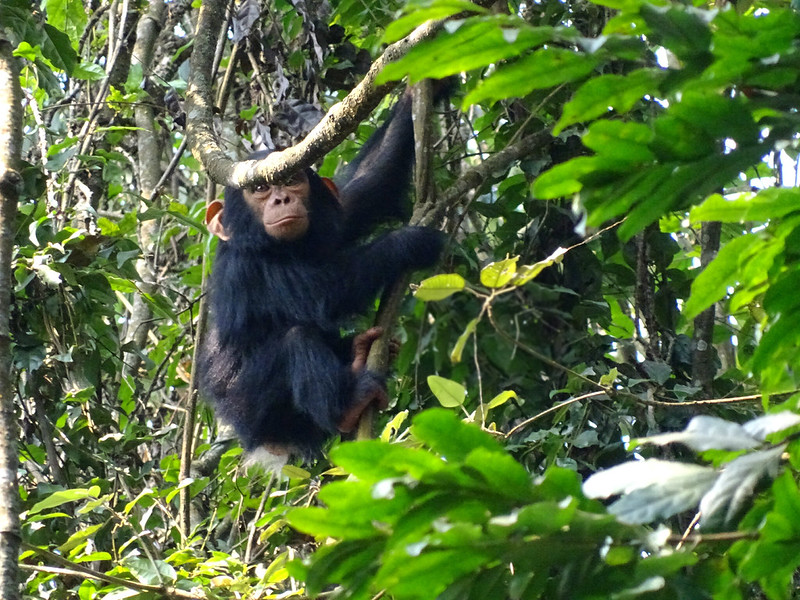
Observing the chimpanzees evokes a comparable sense of awe and exhilaration, accompanied by noticeable primate sounds, without the $1,500 expense associated with gorillas
We firmly believe this is valuable for both travelers staying in Kigali and vacationers. The chimpanzee trekking in Rwanda is an experience undoubtedly cherished forever.
Beginners Guide to Chimpanzee Trekking
Chimpanzee trekking in Nyungwe Forest National Park begins from any of the 3 sections including: Uwinka reception, the Kitabi reception center and Gisakura reception centers. Nyungwe National Park has 2 troops of habituated chimpanzees which are set for tourism purposes, with one at Uwinka, and the other at Cyamudongo forest, which is situated in the Eastern Park of the Park.
Cyamudongo, having been isolated from the main Nyungwe forest, facilitates the identification of chimpanzees. We do strongly suggest this location but you will have to arrange in advance as only eight persons are allowed go chimpanzee trekking per day.
Gisakura Reception Center is where you’ll start and end the Cyamudongo chimpanzee trek. You need to check in by 5 pm the day before.
- The cost for chimpanzee trekking in Rwanda is $250 per individual ($135 for international residents).
- Book your reservation between one and two months in advance (or as soon as you are aware, in fundamental terms).
- Getting up at 4:30 am is necessary to meet your helper at 5:00 am.
- The drive to the beginning of the chimpanzee trekking at Cyamudongo takes less than two hours.
- It is essential to possess a vehicle that is capable of traversing uneven conditions. A four-wheel drive vehicle is advised.
- Grab a snack or lunch to take with you on your ongoing adventure.
- Prepare cash or ensure your MTN Momo account is funded with $20 for a porter and $30 for trackers.
Accommodations Near Nyungwe National Park
We strongly advise staying at Chimpanzee Lodge when visiting Cyamudongo. The location is about 5 minutes from the 5 am gathering place for the journey to the Cyamudongo forest entrance.
Chimpanzee Lodge offers clean accommodations, somewhat hot water, and exceptionally welcoming personnel.
You can also consider booking other lodges, such Nyungwe Top View Hill Hotel, Ear Ken Barham Guesthouse , not forgetting the luxurious One And Only Nyungwe House.
How to Book Chimpanzee Trekking
Contacting us at book@aloyosafaris.com, or directly via our contact us page or through whatsApp to arrange your date and payment., is the perfect and qickest way to book. You may verify with them the specific location of your hike. They initially occupy Cyamudongo, followed by the more extensive region of the park.
Foreign: Chimpanzee trekking $150 plus park entry fee $100 equals a total of $250.
Foreign resident: Chimpanzee tracking $60 park entrance + $75 chimpanzee tracking = $135 total
It is imperative to communicate directly with Aloyo Safaris through email to prevent any excess administrative fees imposed by third parties.
Coordinate your dates with us, send us your passport details, then later after an ideal alignment with your program, we will send the payment link where you can make your permit booking fee.
Prior your chimpanzee trekking in Rwanda, you are required to check into the Gisakura Reception Center no later than 5:00 p.m. on the day prior. This enables the park to verify your documents.
About Nyungwe National Park
Nyungwe National Park is a vast rainforest encompassing more than 1,000 square kilometers. It nourishes both the Congo and Nile Rivers and is replete with biodiversity. The forest hosts 345 bird species and 85 mammalian species, containing 13 of Africa’s primates. Although chimpanzees are the primary attraction, you may also likely observe black-and-white colobus, blue monkeys, and vervet monkeys. Additional primates that may be observed include L’Hoest’s monkeys, owl-faced monkeys, red-tailed monkeys, golden monkeys, crowned monkeys, Dent’s mona monkeys, olive baboons, and grey-cheeked mangabeys.
The park is designated as a UNESCO World Heritage Site and comprises two distinct forest regions. The first aspect is the vast area of Nyungwe National Park depicted on the map.
The second is a little, isolated forest known as Cyamudongo, which was severed from the primary park due to agricultural activities and tea plantations prior to the region’s formal protection. In the primary area of Nyungwe, locating chimpanzees can occasionally prove challenging due to the vastness of the forest. Because there is only one chimpanzee family and a considerably smaller land area, it is easy to find them in Cyamudongo.
Despite the fact that the Cyamudongo chimp population faces some inbreeding issues due to its seclusion, there are plans to eventually re-introduce chimps from the greater Nyungwe forest. Luckily, the people are not in danger right now.
Long-term plans exist to interconnect the two forest ecosystems; however, this endeavor is exceedingly challenging due to the presence of local farms, grazing pasture, and settlements occupying the surrounding space.
It’s crucial to remember that chimpanzees are still wild creatures and do not wear trackers when trekking in Rwanda. The forest ranger trackers precedes your group to assist in locating the chimpanzees prior to your arrival. However, some reports indicate that some individuals do not observe the chimpanzees during their walk. Bear it in mind.
Chimpanzee Trekking in Cyamudongo
Upon completing the approximately two-hour drive to Cyamudongo, you will reach the visitors’ center, where you can access the restroom and enjoy some of your packed meal while receiving a briefing.
Subsequently, you will commence! The descent into the forest is quite steep, and we strongly suggest you hire a porter. They are exceptionally considerate; they are not obligated to carry your suitcase if it causes you discomfort. They can direct you on foot placement and assist in maintaining stability on the trail.
The duration to locate the chimpanzees may range from 40 minutes to 2 hours.
Watching chimpanzees upon meeting them is quite remarkable experience. The chimpanzees are incessantly vocal and screaming throughout.
Chimpanzees are the closest relatives of humans. We share approximately 96% to 98.9% of our DNA with them. Humans retain a connection to the sounds of chimpanzees and hat we can comprehend certain chimpanzee hand gestures. Totally silly. You will receive all the information from the guide while observing the chimpanzees.
Visitors are permitted to spend approximately 40 minutes to an hour with the chimpanzees before returning to the starting point
Chimpanzee trekking schedule In Rwanda
The Day Before
1700hrs – Arrive at the Gisakura Reception Center to verify your guide and settle payment.
6:00 p.m. — Proceed to your Lodge, unwind, dine, and prepare your packed breakfast.
Day of Trekking
4:30 a.m. — Awaken, vacate accommodations, and collect your prepared breakfast.
4:45 a.m. – Proceed to the designated meeting location We strongly suggest arriving many minutes in advance.
Drive to Cyamudongo between 5:00 and 6:45 a.m.
7:00-10:20 a.m. – Trek and observe the chimpanzees. This represents the minimum duration of your experience. You may hike for two hours to locate them.
11:00 a.m.–1:00 p.m. – Return to the primary roadway and proceed with your journey.
In the afternoon or evening, You will be driven back to Kigali.
Tipping Advice
- 5,000 RWF for local dancing artists;
- $20 for porters. If you are a group, consider acquiring two porters. Regardless of whether you employ a porter, if you use their services, it is advisable to provide a gratuity.
- Trackers cost $30.
We strongly suggest you to carry either dollars, euros, or local currencies to provide gratuities to the trackers and porters. MTN Momo is also available for locals and residents; however, the signal will only be received in the parking lot. Therefore, it is recommended that you obtain a tracker’s number and provide it to Momo after.
Things to Bring on a Chimpanzee Trek
- Shoes and Socks: While the trek is not very physically demanding, traversing a jungle necessitates the use of hiking boots for chimpanzee trekking in Rwanda. Running shoes may suffice, if there has been minimal rainfall and they possess adequate tread. It is advisable to wear socks that bridge the space between your trousers and footwear. Numerous fire ants may inhabit the trail we traversed at one point, hence the advisement.
- Dress long pants and a long-sleeved shirt to avoid scratches from vegetation. Long trousers are mandatory; nonetheless, numerous individuals transitioned to T-shirts as temperatures rose.
- Trousers: Possess basic hiking pants that are both comfortable and visually appealing.
Chimpanzee tracking in Rwanda, specially takes place in Nyungwe National Park and Gishwati Mukura national Park, each located in Western Rwanda. This bucket list primate activity, has become the second most sought after primate activity, after gorilla trekking in Rwanda, and is done in Giswati Forest, Mukura Forest & Nyungwe Forest.
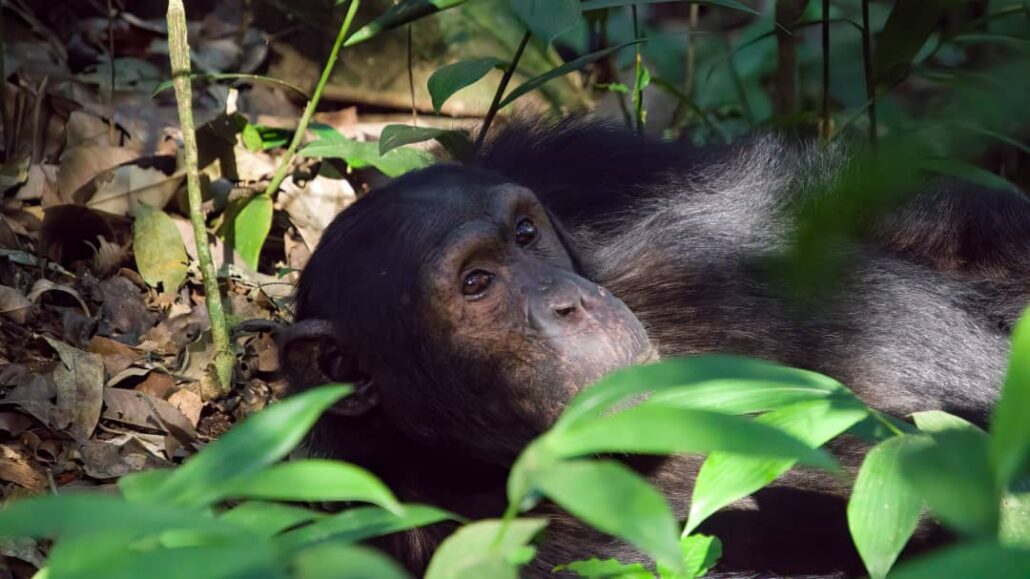
Chimpanzee trekking in Rwanda offers a unique experience of traversing through the thick trails to find the assigned chimpanzee community, to have an intimate interaction with them in their natural habitat. Within a period of 60 minutes, travelers usually enjoy opportunity of watching them feed, play, build their nests among other daily activities.
Like the mountain gorillas, chimpanzees are an endangered species, belonging to the great Ape, who share up to 99.8% of their DNA with humans, thus making them human cousins.
The cost of a chimpanzee trekking experience permit in Rwanda is $150 USD per person for Foreign Non Residents, $135 USD for the foreign residents.
Chimpanzee Tracking In Nyungwe national Park
Located in Southwestern Rwanda bout 5 to 6 hours by road from Kigali City, Nyungwe Forest National Park is celebrated for being a home to about 500 chimpanzee populations, among other 13 primate species noted here.
Chimpanzee trekking in Nyungwe Forest national Park entirely relies on the behavior of the group, and the condition in which they are in. Chimpanzee trekking starts with briefing in the morning, and on finding them, you will be with them for only 1 hours so as to get familiar with their daily schedules. Not only will guests trek chimpanzees, but also have the chance to encounter other primate species like: Vervet monkeys, white & black colobus monkeys among other species.
When To visit Nyungwe For Chimpanzee Trekking?
The best time of the year to visit the park is during the dry months of December, January, February, June, August and September, because the trails are dry or less slippery, light vegetation growth, less/no rains which offers favorable conditions to follow through different trails, searching for chimpanzees. This is the best time to go chimpanzee trekking, although it is also important to note that, it is during this season that chimpanzees wander furthest into the thick forest to look for food, hence leading to longer day treks to locate them.
Rules & Regulations for chimpanzee trekking?
- the age limit for tracking chimpanzees begins from 15 years of age, below which are not allowed to track, neither can they go for habituation.
- Trackers and equally Researchers are not allowed to eat, drink or smoke in the presence of the chimpanzees.
- No visitor is allowed to go against the rules of the ranger guides but instead follow their commands
- Travelers who are suffering from Cold, flu, Diarrhea, fever are not allowed to track chimpanzees,
- All travelers are advised to stand at least 7 to 8 meters further a part from the chimpanzee.
- All visitors are not allowed to provoke chimpanzees since they always need their freedom.